— "The essence of how AI changes the world is turning code into social value"
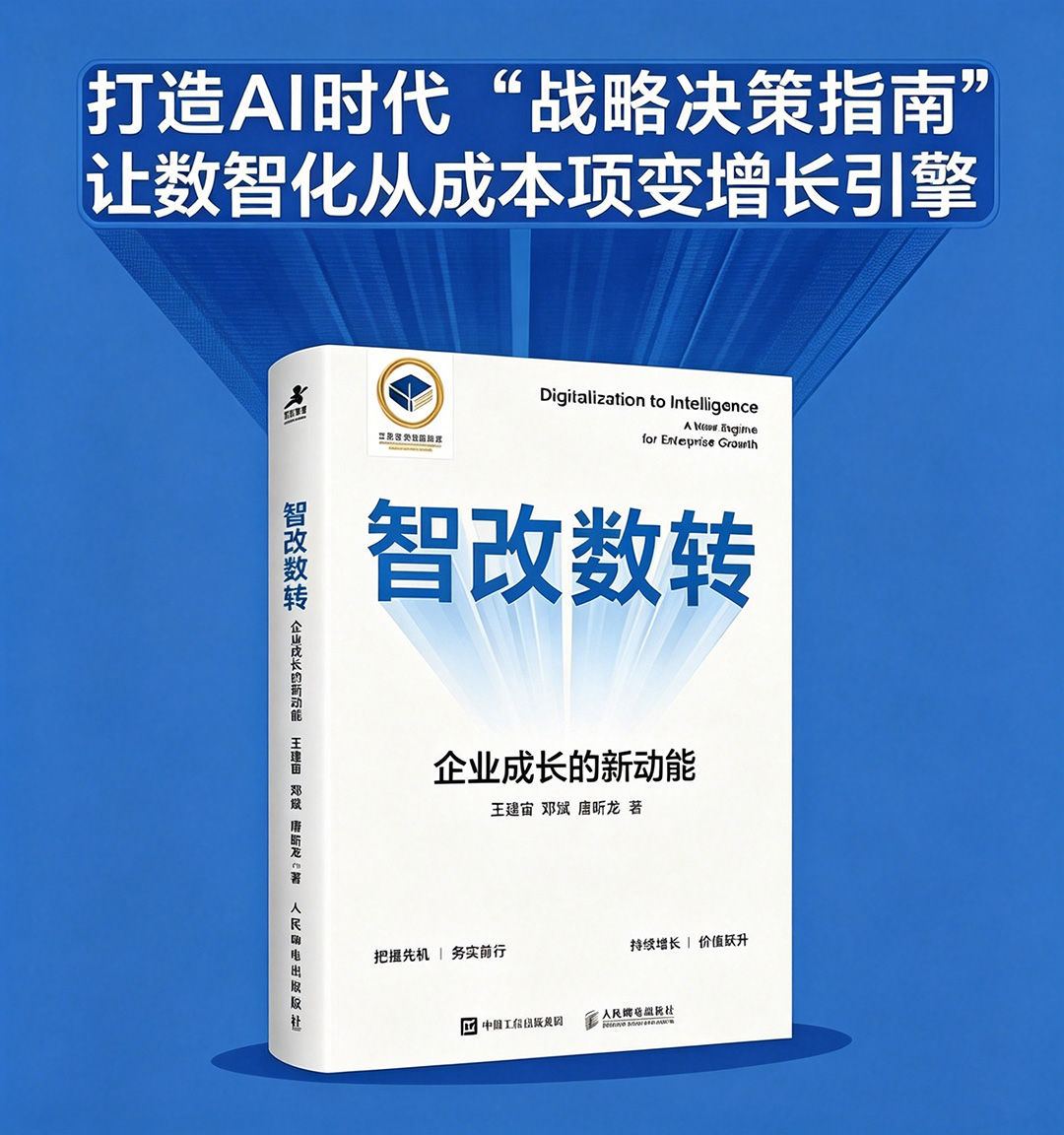
A new book, "Intelligent and Digital Transformation: New Momentum for Business Growth", co-authored by Wang Jianzhou, Deng Bin and Tang Xinlong, has been published by Posts & Telecom Press. Drawing on real cases from 16 Chinese industries and spanning 27 frontier topics, it sets out a reusable method for digital and intelligent transformation. TIDENET (BEIJING) TECHNOLOGY CO., LTD. is included as a typical case of intelligent transformation.
A book in conversation with its time
Set against the convergence of the digital economy and AI, the book grew out of the "Digital China" project at Tsinghua University's PBC School of Finance. Its three authors — Wang Jianzhou, former chairman of China Mobile; Deng Bin, founder of Shuxiangjie; and Tang Xinlong, founder of the school's AI programme — explain why both intelligent upgrading and digital transformation are necessary and strategically important.
From two angles — "digital intelligence empowering every industry" and "a cross-section of digital and intelligent technology" — the book offers business leaders far-sighted, practical paths for transformation. It argues that intelligent and digital transformation is not just a technology upgrade but a systematic effort to reshape processes, rebuild value and respond to market change — moving from connection to intelligence, with data-driven decisions, self-optimizing processes and personalized experiences.
tsan.ai: driving digital and intelligent transformation with technology
Li Kun, founder of tsan.ai, is a technologist with deep experience in software who entered the software product field as early as 2003. He has long worked on low-code and no-code products and technology, and has a distinctive, technically deep view of how AI changes the world.
The essence of how AI changes the world is turning code into social value
Li Kun believes that developing AI is not just about technical breakthroughs but about combining code with real applications to create products and services of social meaning and value. In 2023 he decided to refocus the company entirely on rebuilding systems with AI, opening a new chapter in tsan.ai's digital and intelligent transformation.
The path of AI technology: from low-code to no-code to AI-generated code
Drawing on tsan.ai's own technical practice, Li Kun sees AI evolving through stages — "single-point breakthroughs → democratized tools → customized scenarios → system rebuilding → ethical governance → ecosystem explosion" — with the supporting technology following a path of "AI generates code → AI organizes programs → AI rebuilds business → AI leads systems". Today, AI-generated code is the most rapidly changing and most important link. In code generation, the human–machine interface keeps getting friendlier, moving from low-code to no-code to AI-generated code (Low-Code → No-Code → AI-Code).
Key lessons: how businesses break through in the AI era
The tsan.ai case in the book offers deep lessons. AI is like a catalyst that helps businesses combine and amplify the power of new technologies. Different large models differ in their strengths and cost-effectiveness; the hardest part is integrating them with local systems — especially when delivering to large enterprises and adapting to their scenarios, which involves resource validation and other areas that technology companies have rarely reached before.
Notably, while media coverage focuses on large models' generative abilities, their practical value in writing code is even greater. Li Kun says that in single-point capabilities AI is already very strong: in building individual pages, running simple business or developing small games, it outperforms most programmers in efficiency and ability. tsan.ai itself is restructuring its teams in step with the technology.
The opportunity lies in the fact that AI has not yet achieved a global breakthrough: every iteration opens a window for outsized returns. Entrepreneurs who dare to use AI first will be the first to benefit.
Once AI achieves a global breakthrough, low-code will gradually become no-code, and every entrepreneur will be able to build their own applications, technology products and high-tech businesses. Academician Zhang Bo of Tsinghua University has noted that AI is even disrupting its parent discipline, computer science: future students may need to learn algorithms but not programming.
When starting a business no longer requires programmers — only product managers who fully understand customers, needs and product scenarios — many ideas that could not be realized for lack of programming skills can quickly become ventures. "One-person companies" led by "super-individuals" will then use AI to challenge traditional businesses.
tsan.ai's inclusion in the book recognizes its long work in intelligent transformation and offers a practical example for other businesses exploring the path of digital and intelligent transformation.
Over the past three years, tsan.ai has stepped up its strategic investment in AI and restructured its teams and business, achieving major breakthroughs as it changes from a software services company into an AI services company. It focuses on medium and large organizations, building AI into traditional business systems so that AI truly delivers value, and has developed core products and customer cases in enterprise AI agents (digital employees) and AI dataset building.
As the book puts it, "Intelligent and digital transformation is not a cost item but the core driver of a business's leap forward." In the great wave of the intelligent age, tsan.ai's story is a vivid footnote to the digital and intelligent transformation of Chinese business.