

On March 29, the AIGC and Digital Human Development Forum, launched by the State Key Laboratory of Media Convergence and Communication at the Communication University of China, its Digital Human Research Institute and the China Netcasting Services Association, was held in Chengdu. A key sub-forum of the China Internet Audio-Visual Conference, it brought together heads of large models at leading Chinese companies such as iFLYTEK, Tencent Cloud, 360 and Baichuan Intelligence; leaders of top digital-human and AIGC companies including Alibaba Cloud, Xiaoice, CCTV Yangbo, League of Legends, BlueFocus, Xinyi Technology, Heijing Technology, Magics Technology and Yuanyuan Technology; and scientists from the State Key Laboratory and the head of the Digital Human Research Institute.
Themed "AI Imagination, New Power for Audio-Visual", the sub-forum discussed the latest achievements and frontier applications of AIGC and digital humans in online audio-visual media.
With the development of generative AI, AIGC is bringing revolutionary change to content creation, user experience and interaction. At the forum, leaders and algorithm experts from the Spark, Hunyuan, Baichuan and 360 Brain large models shared their insights.
The forum also published the "AIGC Online Audio-Visual Application Pioneer Cases" (the "Cases") and the 2024 "China Virtual Digital Human Influence Index Report".
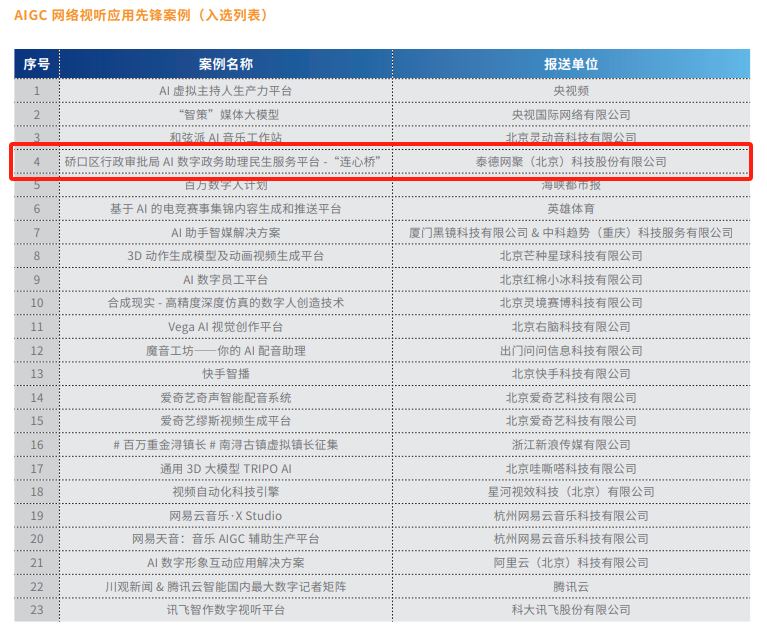
The Cases include 23 foundation models, solutions and applications in audio-visual media from leading Chinese technology companies, among them the "Lianxinqiao" AI digital government assistant and public service platform that tsan.ai built for the Administrative Approval Bureau of Qiaokou District, Wuhan.
The case shows tsan.ai's innovation and practical experience in AI for digital government. With Lianxinqiao, tsan.ai has successfully applied AI to government services, giving the public a more convenient and efficient service.
Built on natural language processing and other AI technologies, Lianxinqiao offers intelligent Q&A, recommendations and processing. Through the platform, residents can easily find government policy information, service procedures and results, and can make inquiries, complaints and suggestions online. This makes government services more transparent and efficient and strengthens interaction and communication between government and the public.
In building Lianxinqiao, tsan.ai took full account of the public's needs and habits, continually refining the interaction design and user experience. This user-centered approach quickly won public recognition and support after launch; after continued refinement along these lines, the platform now covers 190,488 households in Qiaokou and connects 817 grids.
The innovation and practical experience tsan.ai showed in the Lianxinqiao case offer useful lessons for AI in digital government. As technology advances and applications widen, AI in digital government will play an ever more important role, bringing the public more convenient and efficient services.